

Propaganda (n.): The systematic, organized spreading of information, ideas, rumors, or doctrines, often biased or misleading, to influence public opinion, promote a specific cause, or damage an opposing cause.
Paradigm (n.): A standard model, pattern, or framework that defines a way of viewing or acting within reality.
“The Aeneid? Isn’t that just Augustus Caesar’s personal propaganda piece?” I mentally shook hands with my student for knowing this snippet of information ahead of time, but I hesitated to respond affirmatively.
Augustus Caesar did commission The Aeneid to garner support for his leadership after the Civil Wars. What better way to unify Rome than to write an epic which established his divine right to rule? However, there is so much more to the story than this. When we label The Aeneid as “ancient propaganda,” we run the risk of cheapening it and dismissing it as “less than” other classics. Then we miss the richness at the heart of the story.
Ultimately, my student was wrong. Virgil’s Aeneid is not merely a propaganda piece. It is a paradigm of Roman virtue and a shining example of the need for storytelling that lies at the heart of every culture.
The Need for Story
In order to grasp the importance of The Aeneid, we must consider the cultural status of Rome before this epic. What did the Roman people have before The Aeneid? They were culturally “weak” in the sense that they did not possess a great storytelling tradition like the Greeks did. Even their idea of the divine was stripped of the element of personal story. The Romans gods were mostly functional; they had names and practical patronages, but they didn’t carry the brilliance and color of the anthropomorphized Greek gods. Jupiter was not as zesty as Zeus. Juno was not as bitingly jealous as Hera. While they may have shared similar patronages, the Roman gods were bereft of strong personalities because they lacked the personal dimension. They were missing stories.
It wasn’t just the Roman pantheon that lacked a story. The Roman people did too. They had their history, but where was their sense of grand adventure? Where was the romance? Where was the unity? The Civil Wars that preceded Augustus’ rule show that the Romans were struggling to feel at home in a common identity. I would argue that their lack of shared stories contributed largely to this.
Every person and every culture wants to view their lives as an adventure in which they are the heroes. Stories (fictional stories in particular) offer this to us. They raise us above the mundane and help us see our lives as enchanted. They also knit us together in communities. A culture will die out if it doesn’t have stories to rally around. Imagine getting together with your family over dinner and not having any stories to laugh or cry about together. Community is built and strengthened in the forge of storytelling. During Virgil’s time, Rome was striving for glory but it didn’t have that sense of of “home mythology.” Like the Trojans after the Fall of Troy, they were floundering at sea, without a mythology to call their own.
This all changed when The Aeneid burst onto the scene. Finally, the Roman people had a story about them. They had heroes to rival Odysseus and Achilles. They had their own lineage, traced back to the gods. They had a story in which suffering, fate, trial, and the human spirit, were woven together in an incredible tapestry. Virgil gave life and color to the history of Rome through myth. He gave his people a story to not just enjoy but to participate in.
Perhaps nowhere is this more vividly seen than in Aeneas’ journey to the Underworld. On the banks of the River Lethe, Aeneas sees the entire lineage of Roman leaders that will come after him. He sees the glory of the future of Rome, ending with the mournful, elegiac moment in which he sees Marcellus, Augustus Caesar’s young nephew, who was intended to be his uncle’s heir but died suddenly and tragically at 19 of an unexpected illness.1 A shadow flits around the handsome youth’s head, foretelling his death. Apparently, when Marcellus’ mother Octavia heard this part of the poem recited (“tu eris Marcellus”), she fainted, overwhelmed by grief. By intertwining fact with fiction, Virgil offered the Roman people something they were missing. History may have sketched Rome’s outline, but The Aeneid splashed color onto its pages.
A Paradigm of Virtue
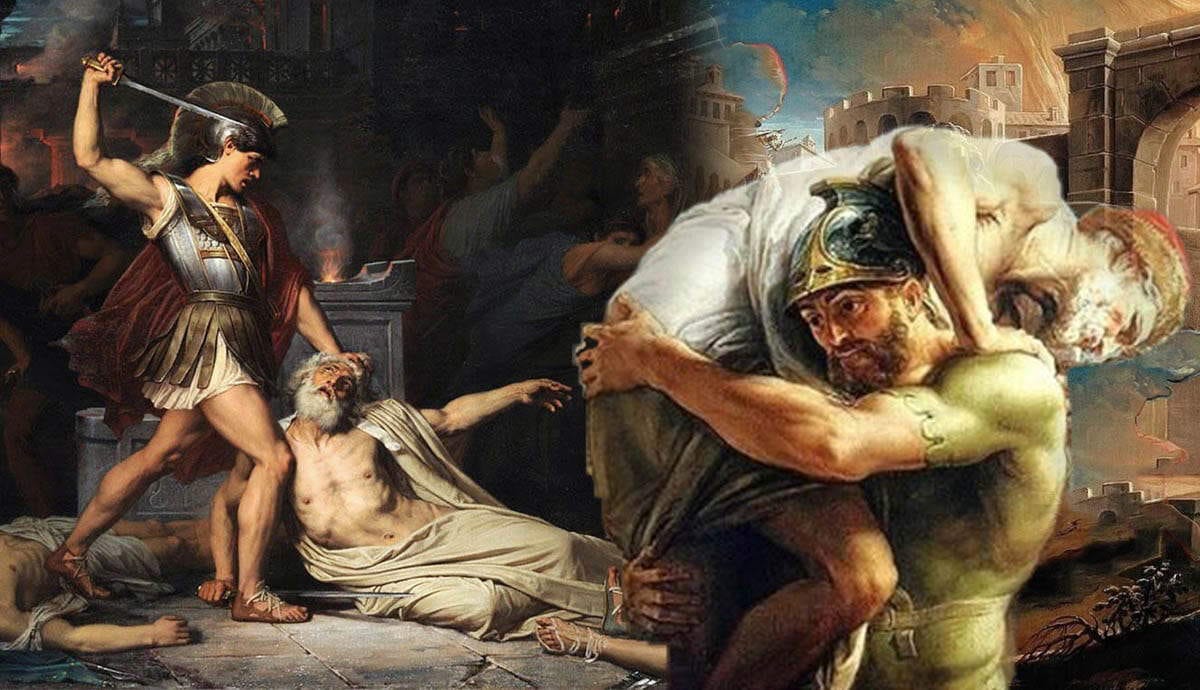
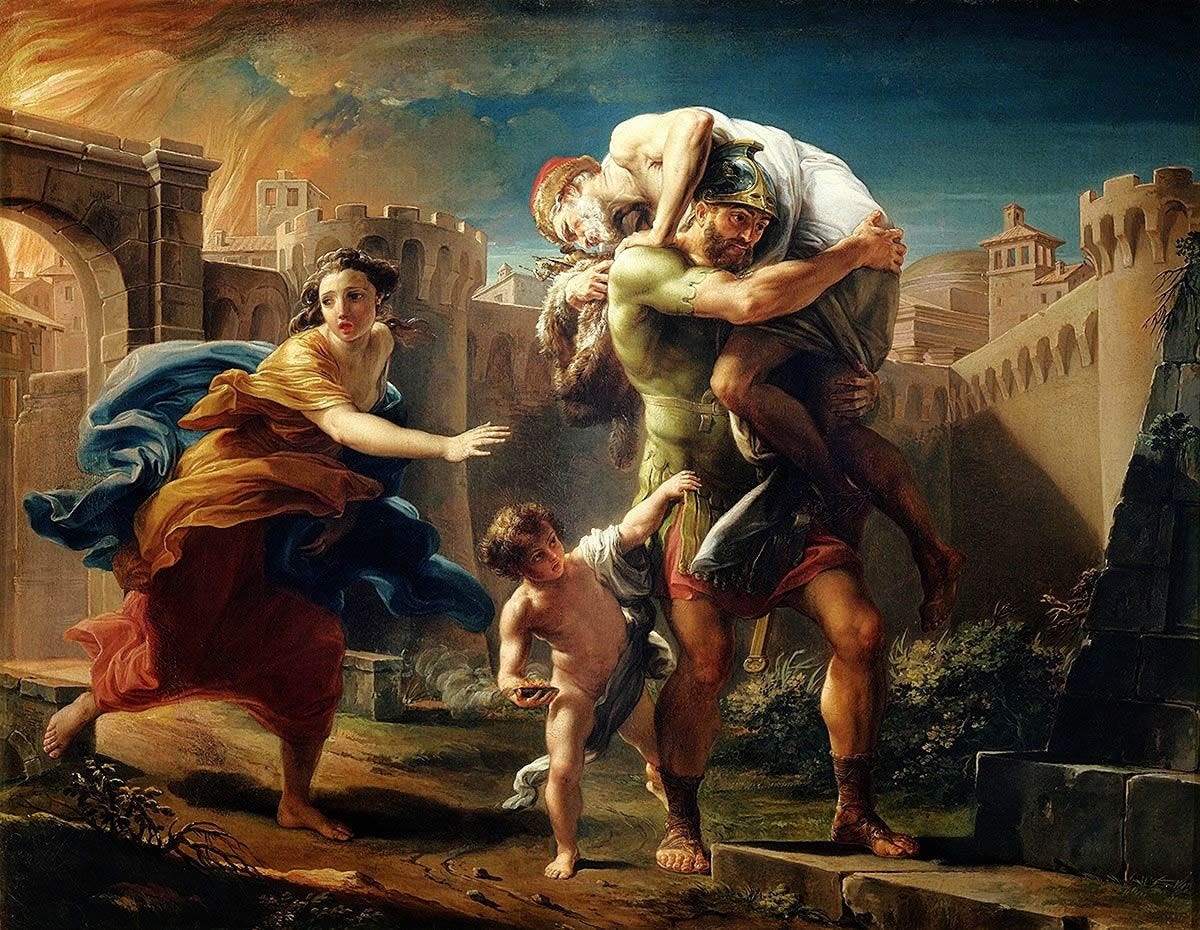
The Aeneid also gave the Roman people a set of values to rally around. Virgil takes great pains to emphasize the virtue of pietas that sets the Roman people apart from other cultures. Pietas, meaning deep devotion, does not only mean respecting the gods. It implies a threefold loyalty to God, country, and family. This virtue is at the heart of Aeneas’ quest. It causes him to heave his father on his back and, carrying their household gods, leave Troy to seek a new land for his people. It also bids him forsake his love for Dido, the queen of Carthage, in order to obey the gods.
Duty-bound,
Aeneas, though he struggled with desire
To calm and comfort her in all her pain,
To speak to her and turn her mind from grief,
And though he sighed his heart out, shaken still
With love of her, yet took the course heaven gave him
And went back to the fleet.
(Aeneid, 4.545-551, trans. Fitzgerald)
Through Aeneas’ devotion, Virgil inspired the Roman people to live for those same values of God, country, and family. Setting these values in fiction injected them with inspiration, romance, glory. The Aeneid taught the Romans what they should live and die for.
Obsessed with “Debunking”
The temptation is strong among young people today to dismiss anything that sniffs of propaganda. Even my brightest, most engaged students are wont to roll their eyes when Virgil inserts what they have coined his “ad breaks for Augustus Caesar”. But propaganda is a cheap word, implying deceit. There is nothing deceitful about The Aeneid. On the contrary, it shines with truth.
The fact is, everything has an agenda in some sense because everything has a point. Having a point is unavoidable (even if your point is that you mistrust agendas). The only alternative to having a point is nihilism. So before we dismiss something merely because it has a motive, we should first ask what that motive is. “Is it a worthy motive?” should be our question, not “Is it a motive?” If it is worthy, we should give ourselves over to its influence. When it comes to The Aeneid, I like to remind my students that the motive here, while partially political in nature, was incredibly noble and necessary for the Roman people. It was a crucial building block for the development of the Roman identity.
Propaganda or Paradigm?
Perhaps we should call the Aeneid rhetoric rather than propaganda. Socrates’ said in the Gorgias that rhetoric can and should be used for good.2 The Aeneid is a paradigm of rhetoric, not a propaganda piece. It is a glorious display, wherein the Roman virtues are built and paraded through the streets of the imagination with all of the fanfare due them. Just as Aeneas raised the walls of Rome on the shores of Latium, so The Aeneid built Rome in the hearts of her people. I for one, am grateful that Augustus Caesar discerned that his people needed a unifying story. Without his commission, I wonder if Rome would have survived the way it did. We need these unifying myths to establish order, authority, and unity among peoples, rallying them around a common belief in objectives virtues.
Maddie Dobrowski is an author and educator from the Pacific Northwest. Her book, The Lord of the Rings and Catholicism, can be found here.

P.S. Join the Love of Literature book club by upgrading to paid! Our next slow-read is “The Return of the King,” starting at the end of June.
Virgil, The Aeneid, 6.1017-18, trans. Fagles: “Oh, child of heartbreak! If only you could burst / the stern decrees of Fate!”